The Shadow Government, Part One: Follow the Money
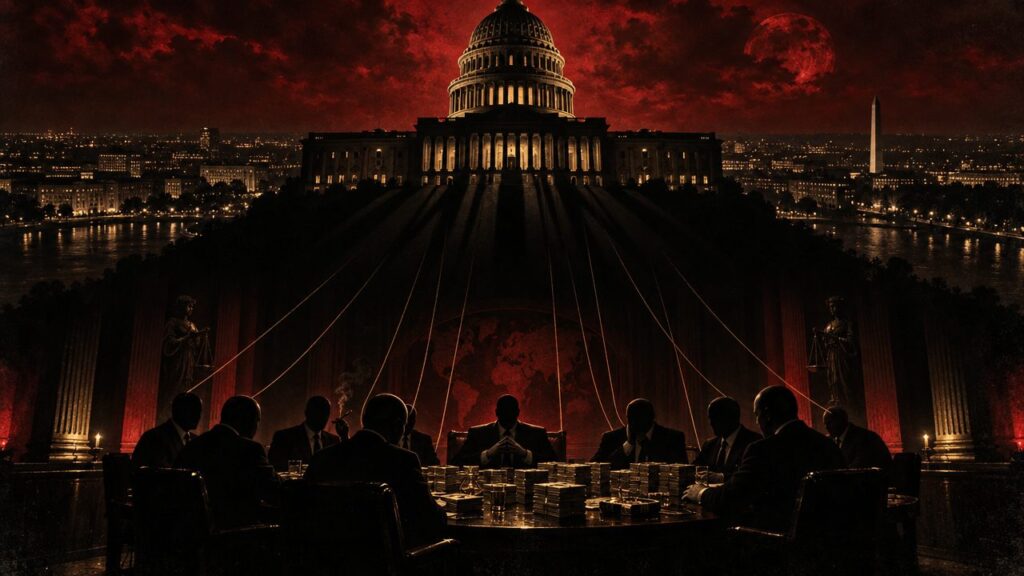
Part One of an ongoing Bottomz Up investigation.
Follow the money, follow the power, and you’ll find the same names again and again. Not lizard people. Not a single smoke-filled room. Something more boring, and far more effective: a permanent class of lobbyists, asset managers, central bankers, and career officials who keep their jobs no matter who you vote for. You can fire a president every four years. You can’t vote these people out, because you never voted them in.
That’s what we mean by “shadow government.” It isn’t hidden because it’s secret. It’s hidden because nobody’s looking. So let’s look.
1. The $5 Billion Front Door
Federal lobbying spending hit a record of roughly $5 billion in 2025, according to disclosure data compiled from Senate lobbying filings. That’s only what gets reported. It doesn’t count “strategic consulting,” think-tank funding, PR campaigns, or the former senator who “advises” a client but never registers as a lobbyist.
Ask yourself a simple question: who in your life has $5 billion a year to spend making sure Congress hears their side first? Not you. Not your church. Not the guy who owns the hardware store. The people who can afford a permanent seat at the table are the ones who end up writing the menu.
2. The Revolving Door
The pattern is so normal Washington has a name for it. Staffers write the regulations, then leave for the industry those regulations govern. Industry lawyers come back in as regulators. Members of Congress retire into lobbying shops. OpenSecrets has tracked thousands of these moves across agencies and Capitol Hill for years.
Nobody has to break a law for this to work. Nobody has to take a bribe. You just have to know that your next paycheck, the one with an extra zero, depends on not making enemies of the people you’re supposed to be overseeing. That’s not a conspiracy. That’s an incentive structure. And incentive structures beat good intentions every single time.
3. Three Firms, One Vote
Here’s a name most Americans couldn’t pick out of a lineup: BlackRock, Vanguard, and State Street. Through the index funds sitting in your 401(k), these three firms vote shares in nearly every major public company in America. A widely cited 2017 academic study by Fichtner, Heemskerk, and Garcia-Bernardo found the “Big Three” were together the largest shareholder in roughly 88% of S&P 500 companies.
Think about what that means. Competing companies, airlines against airlines, banks against banks, often share the same top owners. Those owners vote on board seats, executive pay, and corporate policy. And remember the ESG era, when the same handful of asset managers pushed the same social and climate priorities into boardrooms across every industry at once? That wasn’t a coincidence. That was concentrated ownership doing what concentrated ownership does.
Here’s the kicker: it’s your money. Your retirement savings give them the votes. You just don’t get a say in how they’re cast.
4. The Bank That Runs the Country’s Money
The Federal Reserve sets the price of money for 340 million Americans. Its chair is appointed, not elected. Its twelve regional banks are technically owned by the private member banks in their districts, which hold stock in them by law. In September 2026, the Fed under Chair Kevin Warsh raised rates for the first time since 2023, with a unanimous 12–0 vote. Whether that was the right call or not, ask yourself: when did you get a vote on it? Your mortgage did. Your credit card did. You didn’t.
5. The Court You Can’t See
The Foreign Intelligence Surveillance Court approves government surveillance in secret. Its opinions are classified by default. Congress passed a law requiring certain opinions to be declassified, and in September 2026 The American Prospect reported the administration had blown past a statutory deadline to do so. A secret court, ruling on secret programs, whose rulings stay secret past the deadline the law sets. If that doesn’t bother you, you’re not paying attention.
What This Is, and What It Isn’t
We want to be precise here, because precision is what separates investigation from noise. We are not claiming there’s one man behind a curtain pulling every lever. We are claiming something easier to prove and harder to fix: that a durable network of money, appointment, and secrecy shapes American policy regardless of election results, and that this network is almost entirely unaccountable to voters.
You don’t need a secret society when you have a legal one.
Coming in Part Two
Next, we follow specific names: who moved from which agency to which firm, who funds which think tank, and how a single policy idea travels from a Davos panel to a federal rule. Have a tip? Hit the Contact page. We read everything.
— Bree Bottomz
Sources
- Lobbying spending reached a record $5 billion in 2025 (chart, Senate LDA disclosure data)
- OpenSecrets: Revolving Door database
- Fichtner, Heemskerk & Garcia-Bernardo, “Hidden power of the Big Three?” Business and Politics (2017)
- Schwab: Fed Hikes in 12-0 Vote, Commits to Inflation Fight (Sept. 2026)
- The American Prospect: Trump Administration Ignores Statutory Deadline to Declassify FISA Court Opinion (Sept. 24, 2026)